"I've said it five times": why spoken instructions fade with ADHD
"Shoes on." Silence. "Shoes on, please." Nothing. By the fifth time, everyone's voice is louder. Here's what's actually going on.
You said it calmly. Then a little louder. By the fifth "shoes on!", you're frustrated, they're upset, and you're late.
It looks like ignoring. For most kids with ADHD, it isn't.
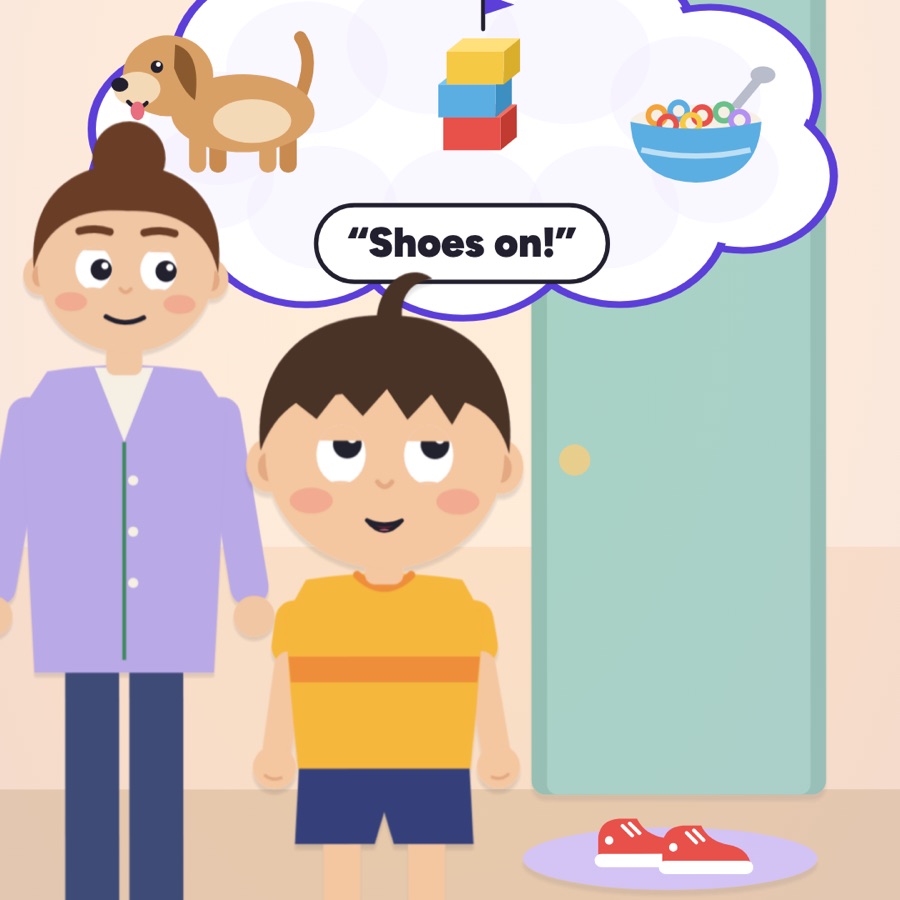
Their brain is already full
When you speak, your child's brain is busy: the dog, the Lego tower, breakfast, a thought about yesterday. Your words have to fight for a place, and spoken words don't stay put.
Words fade fast
Working memory is where we hold an instruction while we act on it. Research shows it's weaker on average in kids with ADHD. A spoken instruction can be there one second and gone the next — even if they heard you and even if they wanted to do it.
Why repeating doesn't work
Saying it again puts the same words into the same leaky place. It also raises the temperature: by the fourth time, the instruction comes wrapped in frustration, and frustration is its own distraction.
What helps: show it, once
- Say it once, then show it. A picture of shoes taped by the door. A card with the next step. The instruction stays where the task happens.
- One thing at a time. "Shoes on." When they're on: "Jacket." Not three at once.
- Get close first. Walk over, make eye contact, then speak. Calling from another room loses the first half.
- Catch the win. "Shoes on, first time. Nice." Attention to what goes right is one of the strongest tools parents have.
The goal isn't a child who remembers everything. It's a home where they don't have to.
If mornings or instructions are a daily fight, a pediatrician or therapist can help; parent training in behavior strategies is a recommended part of ADHD care, especially for younger children.
Stop repeating. Show it once.
CareTec turns your child's routine into steps they can see, one at a time — and shows you what's working.
Build your child's routine →Barkley, R. A. — Taking Charge of ADHD (4th ed., Guilford Press, 2020): externalizing information at the "point of performance".
Martinussen, R. et al. (2005). A meta-analysis of working memory impairments in children with ADHD. JAACAP, 44(4).
CDC — Behavior therapy first for young children
Published 2026-11-06 · Educational content, not medical advice.