An ADHD morning routine that actually works (without the shouting)
Up at seven, out the door at eight, and somehow still late. If school mornings end in shouting, the problem usually isn't effort. It's how the morning is built.
The alarm goes off. Twenty minutes later, your child is sitting on the bedroom floor in one sock, reading the back of a cereal box they carried upstairs. The bus comes in ten minutes.
School mornings ask a lot of any child. For a child with ADHD, they ask for almost everything ADHD makes hard, all at once, against a clock.
Why mornings are the hardest hour
Think about what a "simple" morning involves: wake up, get dressed, eat, brush teeth, find shoes, pack a bag, leave on time. That's a long chain of small steps, each one boring, each one easy to drift away from.
ADHD affects exactly the skills that hold a chain like that together.
- Working memory. The mental notepad that holds "after socks, shoes" is smaller on average in kids with ADHD. Steps fall off the list.
- Time. Psychologist Russell Barkley describes ADHD as partly a problem with sensing time. "We leave in fifteen minutes" doesn't feel like anything until it's suddenly zero.
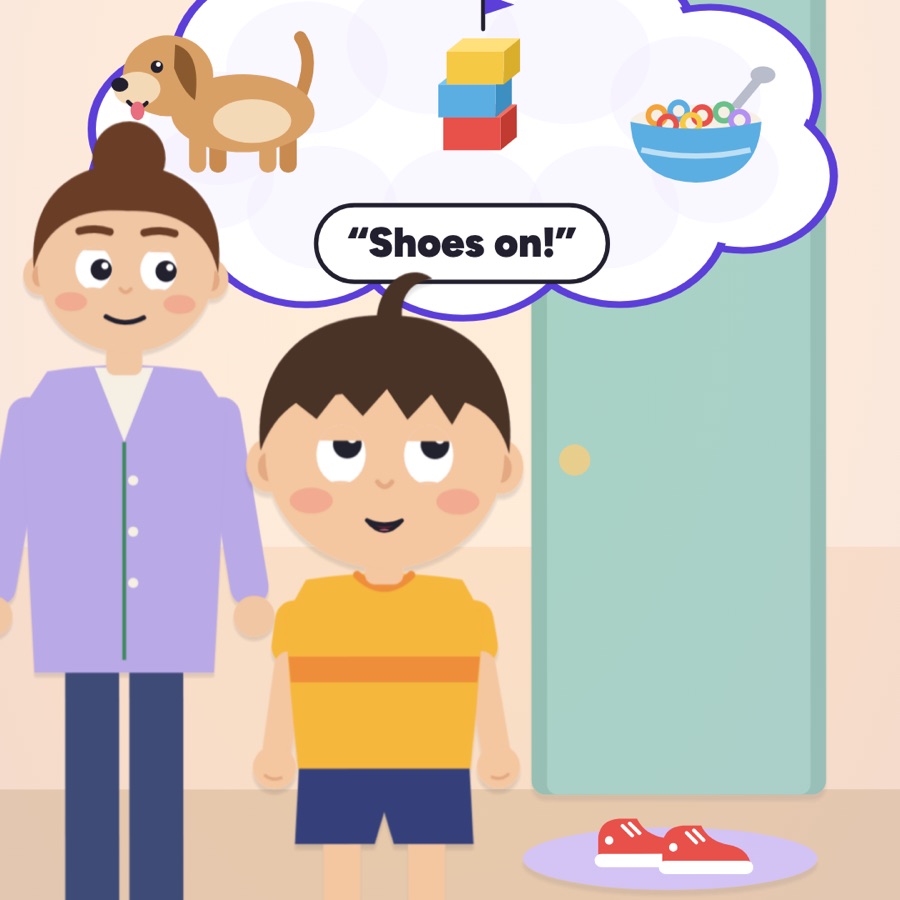
- Distraction. The dog, a toy, a thought about yesterday. In the morning, every room is full of more interesting things than socks.
None of this is a choice. It's a brain being asked to run a long, dull sequence from memory, at speed, before it's fully awake.
The trap: you become the routine
When the steps live only in your head, you end up as the reminder system. "Are you dressed? Shoes! Where's your bag? Teeth!" Every reminder is a small interruption, and every repeat comes out a little louder.
By 7:50, the morning has turned into one long negotiation, and everyone walks out the door upset. The fix isn't more reminders. It's moving the reminders out of your voice and into the room.
Build a routine that runs itself
Barkley's advice for ADHD comes back to one idea: put the help at the "point of performance", where the task actually happens. A morning routine that works is one your child can see, not one they have to remember.
Keep it short. Three to five steps is plenty. "Get dressed, breakfast, shoes and bag." If teeth matter, add them. If the list is ten items long, it will be ignored by Wednesday.
Make every step visible. Put the steps on a card, with pictures, at your child's eye level. One in the bedroom ("get dressed"), one in the kitchen, one by the door. Your child checks the card, not you. You stop being the one who nags.
Move decisions to the night before. Clothes laid out. Bag packed and sitting by the door. Shoes in one spot, always the same spot. Every decision you move to the evening is one less thing to go wrong at 7:40.
Make time something they can see. A visual timer that shows time shrinking usually lands better than "hurry up". Some families set a small alarm for each step: when it rings, it's time for shoes. The clock becomes the reminder, and the clock never sounds annoyed.
What to try tomorrow morning
- Tonight, write three steps on a card. Draw or print a picture for each. Tape it where the first step happens.
- Prepare the door. Bag, shoes and jacket in one place, ready before bedtime.
- Give one step at a time. "Dressed." When that's done: "Breakfast." Not the whole list at once.
- Notice what goes right, out loud. "You got dressed before breakfast. That's the hard part done." Attention to the steps that work is one of the most reliable tools in behavioral parent training.
A good morning routine isn't one your child remembers. It's one they can see.
Be patient with the first week
New routines take time. The first few mornings may still be messy, and that's normal. Keep the steps the same, keep them visible, and resist the urge to add more until the first three are easy.
Reviews of the research have found that behavioral approaches, like clear routines, visible expectations and specific praise, are among the most well-supported ways to help children with ADHD. The CDC recommends parent training in behavior management as a first step for young children with ADHD.
If mornings are a daily battle despite your best efforts, talk to your child's doctor or a therapist. They can help you adapt the routine, and they're the right people for any questions about medication timing or other treatment. You don't have to figure it out alone.
Let the routine do the reminding.
CareTec turns your child's routine into steps they can see, one at a time — and shows you what's working.
Build your child's routine →Barkley, R. A. — Taking Charge of ADHD (4th ed., Guilford Press, 2020): time, working memory and help at the "point of performance".
Pelham, W. E., & Fabiano, G. A. (2008). Evidence-based psychosocial treatments for attention-deficit/hyperactivity disorder. Journal of Clinical Child & Adolescent Psychology, 37(1).
CDC — Behavior therapy first for young children
Published 2026-11-07 · Educational content, not medical advice.