My child did the homework, then forgot to hand it in
You sat with them for forty minutes. The worksheet was done. Two weeks later the teacher says it was never handed in — and it's still in the bag.
There is a particular kind of unfairness that families with ADHD know well.
The homework got done. It took far longer than it should have. There were tears somewhere in the middle, and you stayed at the table through all of it.
Then the grade comes back as a zero. Not because the work was wrong. Because it never reached the teacher — and when you open the bag, there it is, folded into the bottom, under a jumper and a permission slip from October.
It's hard not to take this personally, for everyone. The child feels stupid. You feel like the forty minutes were stolen. And nobody involved actually did anything wrong.
Why this happens: finishing and delivering are two different skills
To a parent, handing in homework looks like the end of a single task. To a child with ADHD, it's a separate task entirely — one that happens the next morning, in a loud room, with no adult nearby and nothing to trigger the memory.
The CDC's description of ADHD includes forgetfulness in daily activities and difficulty organising tasks. "Turn in the worksheet" sits squarely in that territory. It isn't the hard part intellectually. It's the hard part structurally.
The work is finished, so the brain files the whole thing as done. The last step disappears with it.
Why this happens: working memory drops the final instruction
In a 2005 meta-analysis published in the Journal of the American Academy of Child & Adolescent Psychiatry, Rhonda Martinussen and colleagues found consistent working-memory impairments in children with ADHD compared with their peers.
Working memory is the mental sticky note. It holds "give Mrs Patel the sheet in first period" while the child gets off the bus, says hello to a friend, remembers their PE kit and finds their seat. By the time the lesson starts, the sticky note is gone.
Russell Barkley frames this as a problem of performance rather than knowledge: children with ADHD often know exactly what to do and still don't do it at the moment it needs doing. Your child can recite the rule about handing work in. That knowledge just isn't available in the thirty-second window when it matters.
Why this happens: the bag is a black hole
Most systems for carrying work between home and school rely on the child being organised. One folder for everything, loose sheets, a planner that only works if it gets opened.
Joshua Langberg and colleagues studied this directly, testing a structured programme for middle schoolers with ADHD that trained homework recording, materials organisation and planning, with checks by an adult rather than trust in the child's own habits. The useful lesson for home is the principle: organisation improves when it's built as an external system with someone checking it, not when a child is simply told to be more organised.
What helps
Make "hand it in" a visible step. Add it to the end of the homework routine, in writing, with the same weight as the work itself. Done is not a worksheet finished; done is a worksheet in the right place.
Use one folder, in one colour, for one purpose. Everything that travels to the teacher goes in it. Nothing else does. One place beats five tidy places.
Put the folder where the body will hit it. On top of the shoes. On the door handle. Inside the bag with a corner sticking out. Memory fails; obstacles don't.
Build a thirty-second morning check. Not a search, a glance: "Show me the yellow folder." Three seconds of looking beats a reminder shouted from another room.
Ask the teacher for a collection point. Many teachers already have a tray. A short email — "could he put it straight in the tray when he walks in?" — turns a memory task into a location task, which is much easier.
What to say
When the zero comes home. "You did the work. The bit that went wrong was getting it there. Let's fix that bit." Separating the two protects a child who is already drawing conclusions about themselves.
When they say they forgot. "I know. Forgetting is the thing your brain finds hardest. That's why we're building something to remember for you."
At the end of homework. "Work done. Where does it live now?" Asking a question makes the child perform the step. Telling them does it for them.
When you're furious about the wasted effort. Give yourself a line to use instead of the one that's coming: "This is annoying for both of us. Folder, then we're finished."
What to try this week
- Add one line to the end of homework. On paper, where they can see it: "In the yellow folder. Folder in the bag." The routine ends at the bag, not at the pencil.
- Email the teacher one short request. Ask where handed-in work goes, and whether your child can put it there as they arrive. Teachers answer this kind of question quickly because it's easy to say yes to.
- Do a Friday bag empty, together. Two minutes, every week, same time. You'll find things from three weeks ago, and the pile will shrink.
- Count handing it in as the win. When the work comes back marked, notice the delivery, not the grade: "You got it there. That's the part you've been working on."
Questions parents ask
Should there be a consequence for forgetting? Punishing a working-memory failure tends to produce shame rather than organisation, because the child wasn't choosing. What changes outcomes is a system that doesn't depend on remembering. Save consequences for choices; build scaffolding for forgetting.
My child is old enough to do this alone. Am I doing too much? Children with ADHD often need external structure for longer than their peers, and that gap doesn't mean they'll never get there. The aim is to fade your involvement gradually — from doing the check, to asking the question, to a glance — rather than removing it all at once and waiting for the zeros.
Should I use an app or a paper checklist? Whichever one your child will actually see at the moment it matters. A phone reminder that buzzes during a noisy corridor gets dismissed; a bright folder in their hands doesn't. Many families end up using both: digital for you, physical for the child.
The quiet part
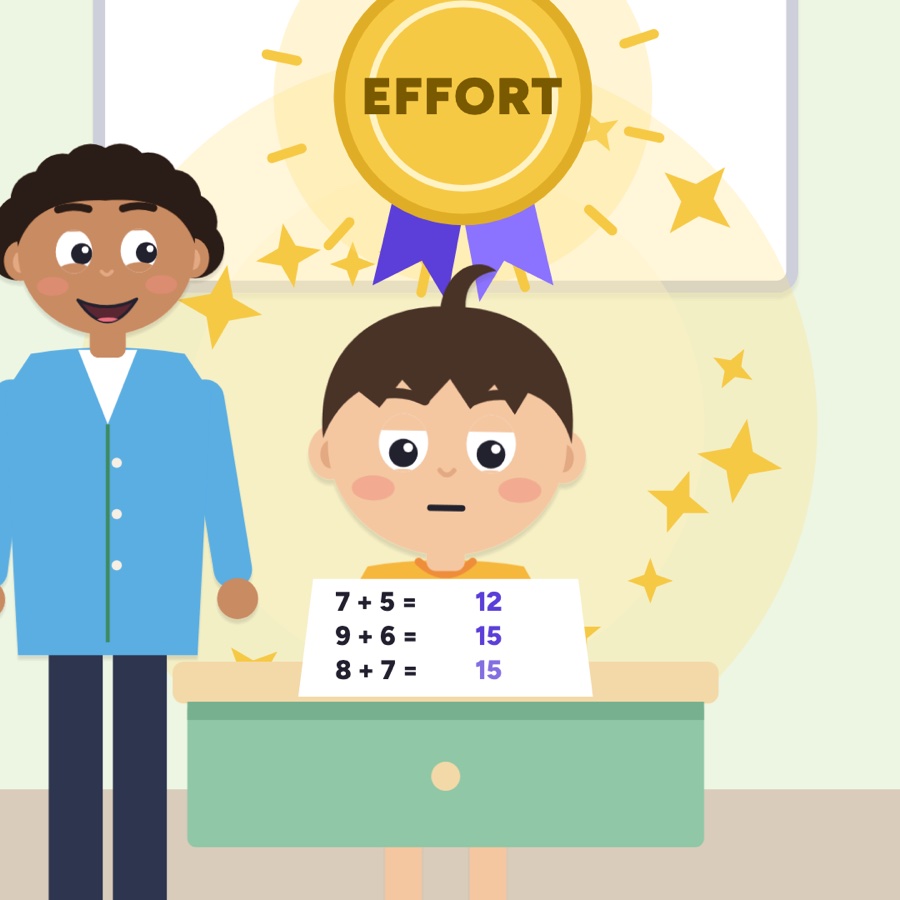
Every zero for work that was actually done chips away at a child's sense of whether effort is worth anything. That's the real cost here, more than the grade.
So when you fix this, say what you're fixing out loud. Not "you need to be more responsible," but "your brain is great at the work and bad at the handover, so we're building a handover."
If homework is consistently taking far longer than expected, or work keeps going missing despite a system, it's worth raising with your child's teacher and your child's doctor. Support at school is something you can ask for.
Make handing it in a step.
CareTec turns your child's routine into steps they can see, one at a time — and shows you what's working.
Build your child's routine →Martinussen, R. et al. (2005). A meta-analysis of working memory impairments in children with attention-deficit/hyperactivity disorder. Journal of the American Academy of Child & Adolescent Psychiatry, 44(4).
Barkley, R. A. — Taking Charge of ADHD (4th ed., Guilford Press, 2020).
Langberg, J. M. et al. (2012). Evaluation of the Homework, Organization, and Planning Skills (HOPS) intervention for middle school students with ADHD. School Psychology Review, 41(3).
CDC — ADHD: signs and symptoms
Published 2026-11-12 · Educational content, not medical advice.