Why does my child with ADHD talk nonstop?
It starts before you've had coffee and it is still going at bedtime. You love them, and you would pay money for ten minutes of silence. Both of those are allowed.
There's a particular kind of tired that comes from being talked at all day.
Not the talking itself — a lot of it is wonderful, and funny, and the reason you know everything about sharks. It's that there is no gap in it. No pause where you get to think, or answer the phone, or finish a sentence to another adult.
Parents describe reaching the end of the day with a headache and a guilty feeling about the headache. That's the part worth saying out loud: being worn out by the talking doesn't mean you're doing anything wrong.
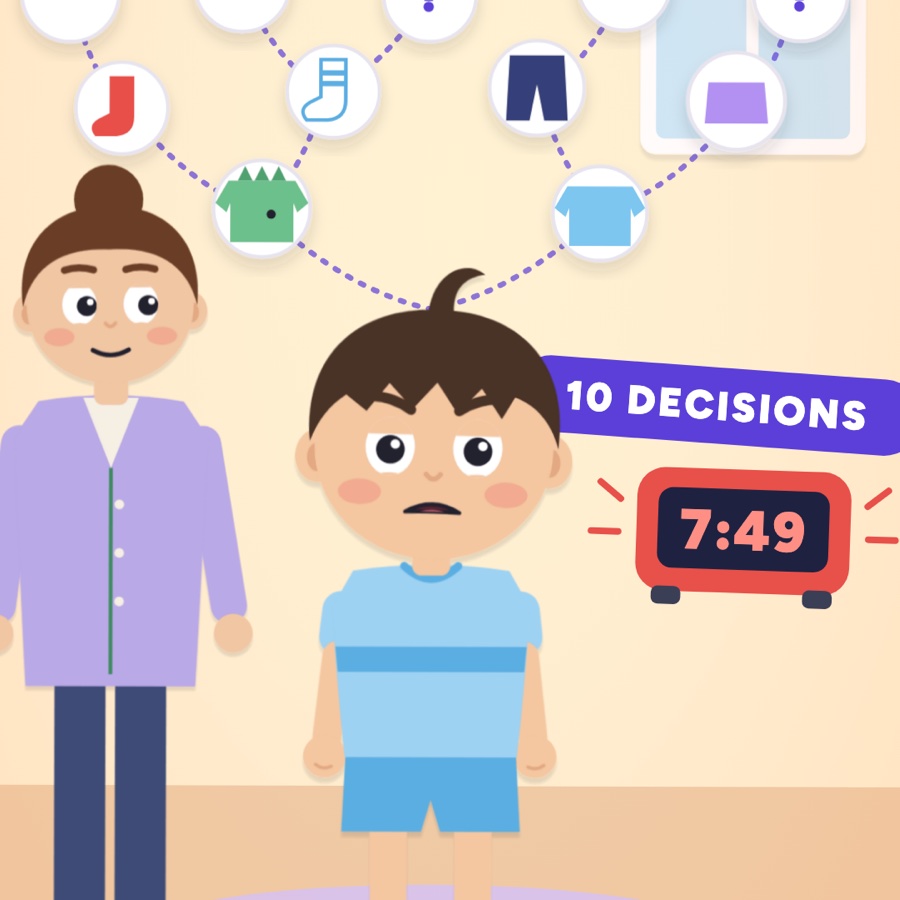
Why this happens: the pause is the hard part, not the talking
The CDC's description of ADHD symptoms includes talking excessively and difficulty waiting for a turn. Those two appear together for a reason.
Russell Barkley's account of ADHD puts the core difficulty in self-regulation — specifically, in inhibition: the ability to stop an action that is already in motion. Most of us have a half-second gap between having a thought and saying it. That gap is where we notice the other person is mid-sentence, or that the room has gone quiet, or that we already said this.
With ADHD, that gap is shorter. The thought and the sentence arrive almost together.
From the inside, it feels like this: the thought isn't waiting patiently, it's pushing. And underneath it there's a real fear — if it isn't said now, it's gone. Not "I'll remember it later." Gone. Adults with ADHD describe exactly the same thing, decades on.
That's why "wait a minute" so often fails. You're asking your child to hold something they can't reliably hold.
Why this happens: talking is also how the thinking gets done
There's a second reason, and it changes how you respond to it.
A lot of children with ADHD think out loud. The talking isn't a report on finished thoughts — it's the process itself. Narrating the Lego build is how the Lego build happens. Explaining the game is how they work out the rules.
Thapar and Cooper, in their 2016 review in The Lancet, describe ADHD as a neurodevelopmental condition affecting far more than attention, including the self-regulation of behavior and of what gets expressed. The 2021 World Federation of ADHD International Consensus Statement describes the same territory: differences in the systems that manage inhibition and working memory.
Put those together and the nonstop talking makes sense. Working memory is short, so thoughts have to be said before they vanish. Inhibition is thin, so they come out as they arrive. And the talking itself is doing useful work.
Which means the goal isn't a quiet child. It's a household where the talking has somewhere to go and the adults can still function.
Why this happens: the day has been full of holding it in
Teachers often describe a child who is relatively quiet in class. Parents of the same child describe a flood from four o'clock onwards.
That's not inconsistency. It's the bill arriving. A school day spent not blurting out is hours of effort, and the effort runs out at the front door. Many families find the talking is heaviest in exactly the window after school, and lightest on days with no school at all.
Knowing that helps, because it tells you when to plan for it rather than fight it.
What helps
Give it a scheduled landing place. Ten minutes, same time each day, where you sit down and they tell you everything. No phone, no cooking, no half-listening. Parents who do this say the rest of the day gets quieter, because the child isn't competing for attention they're no longer sure of.
Replace "stop talking" with "not now, and then." A pause your child can trust works. A pause with no end does not. "Hold that one. Tell me in the car." Then actually ask in the car, or the system dies in a week.
Give the thought somewhere to live. A notebook, a notes app, a whiteboard in the kitchen. The real fear is losing the idea; writing it down removes the fear. Older children take to this quickly once they see it works.
Protect the moments you genuinely need. Phone calls, conversations with other adults, the ten minutes before dinner. Agree a signal in advance — a hand up, a timer on the counter — rather than inventing a rule mid-sentence. Signals are much easier to accept than sudden silence.
Check the quiet gaps. For many children, long periods with nothing engaging produce the heaviest talking. A quick movement break, a task, something in their hands — these often reduce it more than any instruction does.
What to say
When you need a pause. "Hold that thought. I want to hear it — give me two minutes." Then come back. The coming back is the whole method.
When they've told you the same thing four times. "You really like that one." Warm, honest, and it doesn't shame them for a memory gap they can't control.
When they interrupt you mid-sentence. "Finish my sentence, then yours." Short and repeatable. A lecture about interrupting takes three minutes and teaches nothing.
When you're worn out and it shows. "My ears are tired. Not your fault — I just need quiet for a bit." This is the sentence that stops a child concluding they are too much. Say the tiredness, not the verdict.
When they're talking over another child. "Ten seconds each, then swap." Turn-taking works far better as a visible rule than as a social expectation.
What to try this week
- Set one ten-minute listening slot a day. Same time, no screens, no tasks. Tell your child it exists and what it's for. Watch what happens to the other hours.
- Put a notebook or whiteboard where the talking peaks. Kitchen, car, bedside. Then show them once how to park a thought in it instead of losing it.
- Agree one signal for "I can't listen right now." Choose it together, calmly, before you need it. A signal agreed in advance is a tool; a signal invented in frustration is a rejection.
- Plan for four o'clock. If after-school is the flood, decide in advance what the first twenty minutes look like — snack, movement, your undivided ten minutes — rather than meeting it cold while making dinner.
Questions parents ask
Is nonstop talking a sign of ADHD? Talking excessively and difficulty waiting for a turn both appear in the CDC's description of ADHD symptoms, but no single behavior identifies ADHD. What clinicians look at is a pattern across settings over time, and only an evaluation can answer the question properly. If you recognise your child in several of these patterns, that's a conversation for your child's doctor.
Am I harming my child by asking for quiet? No. Children need to learn that other people's attention isn't infinite, and they learn it better from a calm, honest request than from an adult who suppresses it until they snap. The thing to avoid is the message that the child themselves is too much.
Will they ever learn to let other people talk? Turn-taking improves with development and with practice, and it improves faster when it's taught explicitly — visible turns, short slots, a signal — than when it's only corrected after the fact. Many adults with ADHD still manage it with deliberate tactics rather than instinct, and that's a workable life, not a failure.
The talking is not the problem to solve
Somewhere in it is a child who is interested in everything and trusts you with all of it. That doesn't last forever, and plenty of parents of teenagers will tell you they miss it.
What you can fix is the structure around it: a daily slot where they get your full attention, a place to park thoughts, a signal for the moments you need, and an honest sentence when your ears are done.
If the talking comes with real difficulty at school or with other children, bring it to your child's doctor rather than filing it under personality.
Give the talking a landing place.
CareTec turns your child's routine into steps they can see, one at a time — and shows you what's working.
Build your child's routine →Barkley, R. A. — Taking Charge of ADHD (4th ed., Guilford Press, 2020).
Thapar, A., & Cooper, M. (2016). Attention deficit hyperactivity disorder. The Lancet, 387(10024).
Faraone, S. V. et al. (2021). The World Federation of ADHD International Consensus Statement. Neuroscience & Biobehavioral Reviews, 128, 789–818.
CDC — ADHD: signs and symptoms
American Academy of Pediatrics — HealthyChildren.org: ADHD
Published 2026-11-13 · Educational content, not medical advice.