Why won't my child with ADHD brush their teeth or get in the shower?
It takes two minutes. You have asked four times. They are standing in the bathroom, doing nothing.
Of all the daily battles families describe, this is the one that makes parents feel the most unreasonable.
It is two minutes. The toothbrush is right there. You have asked, then asked again, then raised your voice, and your child is standing in the bathroom holding a toothbrush and staring at the wall. Or the shower has been running for eleven minutes and nobody is in it.
It looks like defiance, and it almost never is. Hygiene routines happen to sit on top of several of the exact things ADHD makes hard, all at once, at the worst time of day.
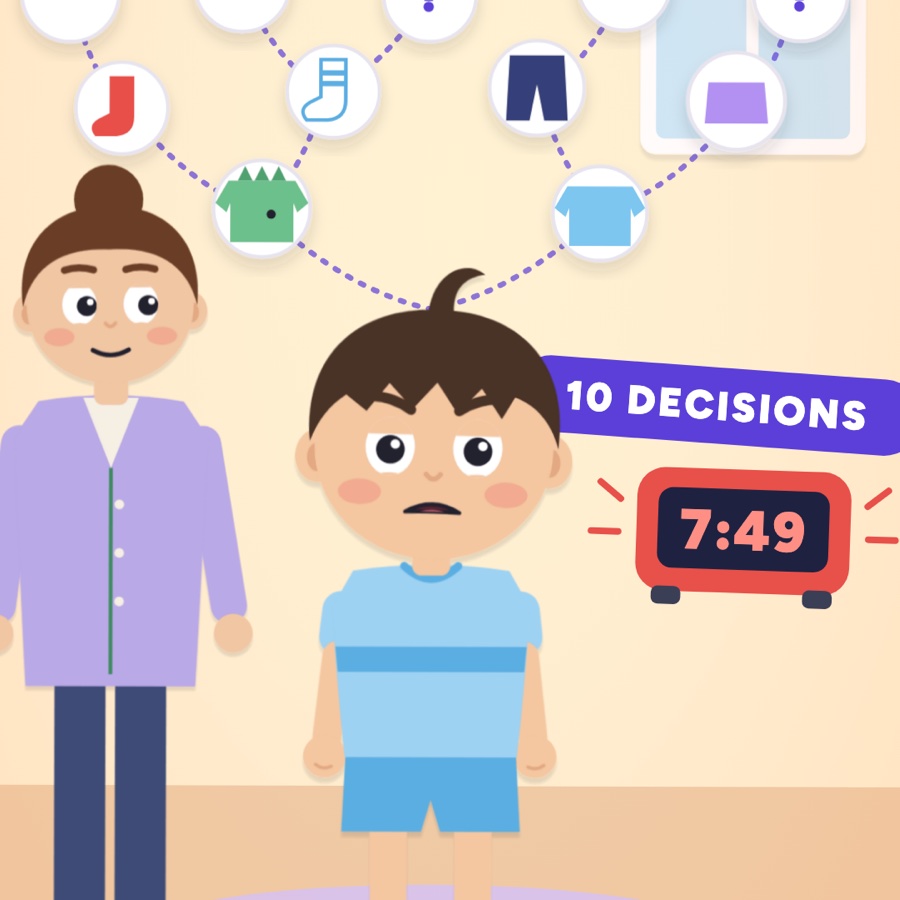
Why this happens: the instruction is gone before they reach the bathroom
Start with the simplest explanation, because it is usually the right one.
Barkley describes working memory — holding a plan in mind while you carry it out — as one of the core difficulties in ADHD. "Go and brush your teeth" has to survive a walk down a corridor, past a cat, a window and a pile of Lego.
It frequently does not. Your child genuinely arrives in the bathroom without the instruction. They are not ignoring you from in there; they are standing in a room with no idea why.
This is why repeating yourself louder changes nothing, and why a card taped to the mirror changes a surprising amount.
Why this happens: a boring task with no reward attached
The second reason is motivational, and it is not about character.
Brushing teeth has no interesting part, no visible result, and a payoff measured in decades. For a brain that is strongly pulled by what is immediate and interesting, that combination is close to the worst case. The same child who cannot start a two-minute job will happily spend forty minutes building something.
Barkley's framing is useful here: ADHD is not a deficit of knowing, it is a deficit of doing what you know at the moment it matters. Your child knows about teeth. Knowing is not what is missing.
It also explains why the lecture never works. Explaining cavities to a child who already understands cavities adds information to a problem that was never about information. What is missing is a push at the moment of starting, and a lecture arrives too late to be that push.
Worth noticing, too, that this happens at the end of the day. Whatever capacity your child had for boring, unrewarding tasks was spent at school hours ago. By eight in the evening there is very little left, which is why the same request that works on a Saturday morning collapses on a Tuesday night.
Why this happens: showers can feel genuinely unpleasant
For some children there is a third layer. Water temperature, the noise, the feeling of being wet, shampoo near the eyes, the cold moment of getting out — these can be experienced far more intensely than you would expect.
Thapar and Cooper describe ADHD as a condition whose effects run well beyond attention, including how strongly a child reacts to what they experience. Plenty of families describe a child who genuinely dreads the shower while being perfectly happy in a bath, or the reverse.
If your child reacts the same way every time, to the same part of it, that is worth taking at face value rather than arguing with. Changing the part they hate is usually easier than changing their mind about it.
What helps in the bathroom
Put the routine where their eyes are. A short list on the mirror — brush, rinse, face, pyjamas — does the remembering so your child does not have to. Pictures work better than words for younger children, and either beats a parent shouting up the stairs.
Go with them, at least at the start. Standing in the doorway is not babying a nine-year-old. It is supplying the thing their brain does not yet supply by itself. You can fade out later; you cannot fade out from something that never got going.
Attach it to something that already happens. After pyjamas, before story. A routine stapled to an existing anchor runs more reliably than one that floats in the evening somewhere.
Make the two minutes have a shape. A song, a sand timer, an electric brush that buzzes when it is done. An end point you can see turns an open-ended chore into a short, finite one.
Fix the part they hate, not the whole. A shower cap for the hair-washing nights. Warmer water, or a towel already on the radiator. Hair washed twice a week rather than daily. Removing the worst thirty seconds often removes the whole fight.
Move it earlier. Everything is harder at 8:30 p.m. A shower straight after school, or teeth before the evening unravels, costs nothing and skips the hardest hour of the day.
What to say
Instead of "go and brush your teeth." "Bathroom. I'll come with you." Fewer words, and your presence carries the plan down the corridor.
When they are standing there doing nothing. "What's step one?" Not a telling-off — a prompt that restarts the sequence they lost.
When they say they already did it. "Show me the wet toothbrush." Light, factual, not an accusation. Children with ADHD often genuinely believe they did a thing they only thought about.
When the shower is the problem. "Which bit do you hate most?" Then change that bit. You will usually get a very specific answer.
When it finally goes smoothly. "You went in and got it done. That's the hard part." Name the starting, because starting is what was difficult.
What to try this week
- Tape a four-step list to the mirror tonight. Written by your child, in their words. Watch how much less you have to say.
- Walk them to the bathroom instead of calling. For one week, no shouting from another room. Count the arguments before and after.
- Move the whole evening routine thirty minutes earlier. Not longer, earlier. Most of what looks like defiance at 8:30 is simply a child who has run out.
- Cut one unpleasant thing out. Hair washed on two set nights instead of every night, or a cap, or a different shampoo. Keep the rest.
Questions parents ask
Is this laziness? No, and it is worth being firm about that, because children hear the word and keep it. A child who can concentrate for an hour on something they love and cannot start a two-minute chore is showing you a difference in how effort is mobilised, not a difference in how much they care.
My child is eleven. Shouldn't they be doing this alone by now? Children with ADHD often need this kind of scaffolding for longer than their classmates, and that gap is well recognised. Supporting a routine for another year or two is not holding them back. Removing support before it is internalised is what tends to cause the slide.
What about the dentist? Tell them. Dentists see this constantly and can suggest practical things — a different brush, fluoride advice, shorter targets. If you are worried about your child's teeth specifically, that conversation belongs with the dentist or your child's doctor rather than with the bathroom door.
Two minutes, made automatic
The goal is not a child who is enthusiastic about dental hygiene. No such child exists.
It is a routine that runs without a fight: visible where it happens, attached to something that already happens, short, and with the worst part taken out. Build that once, and you get the evening back.
Put the routine on the mirror.
CareTec turns your child's routine into steps they can see, one at a time — and shows you what's working.
Build your child's routine →Barkley, R. A. — Taking Charge of ADHD (4th ed., Guilford Press, 2020).
Wolraich, M. L. et al. (2019). Clinical practice guideline for the diagnosis, evaluation, and treatment of attention-deficit/hyperactivity disorder in children and adolescents. Pediatrics, 144(4).
Thapar, A., & Cooper, M. (2016). Attention deficit hyperactivity disorder. The Lancet, 387(10024).
American Academy of Pediatrics — HealthyChildren.org: ADHD
CDC — Behavior therapy first for young children with ADHD
Published 2026-11-14 · Educational content, not medical advice.